AgentClass & AgentSession
An AgentClass is everything an agent is allowed to be — reviewed once, pinned, reused.
An AgentSession is one run of that class — scoped, budgeted, audited, and torn down
when it's done. The class is the thing you trust; the session is the thing that acts.
The AgentClass: the reviewable template
An AgentClass is a Kubernetes resource, so you diff it, review it, and pin it like any other. In one place it declares the whole agent:
- Model — which LLM (or nothing, to use the cluster default).
- Prompt — the system prompt that defines the agent's job.
- Tools — the toolspecs, MCP servers, and skills it may use, and nothing else.
- Identity — whose credentials it acts as (agent, passthrough, ask, or dynamic).
- Authorization — the permissions and resource slots it can be granted, checked per action.
- Channels — where it can be reached (bound separately, per install).
- Budgets — ceilings on tokens, turns, and wall-clock time.
Because it's one declarative artifact, "what can this agent do?" has a single answer you can read before it ever runs — not something you reconstruct from scattered code.
The AgentSession: one disposable run
An AgentSession references a class (agentClassRef) and represents a single conversation or task. It gets its
own workspace, its own budget, and its own audit trail, and it is reaped when it goes idle. A session can
never exceed what its class allows — it inherits the class's tools, identity, and authorization, and narrows
from there. Its status tracks the live phase (starting, running, idle, asleep, completed) and the record of
what happened.
Three ways a session starts
The same class produces sessions through any surface:
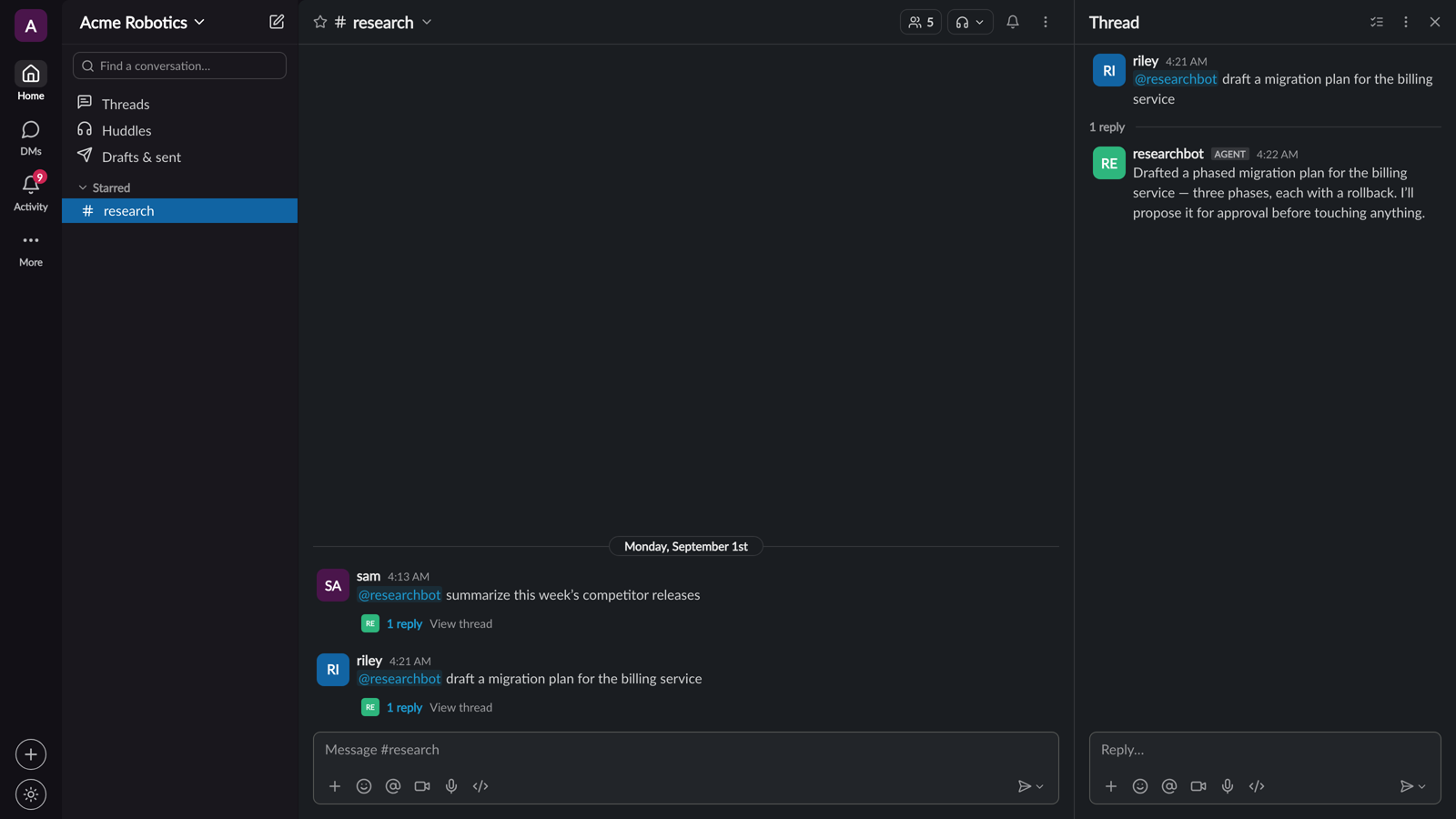
- From a channel — someone messages the agent in Slack, or a webhook fires. The inbound message opens a session bound to that thread. This is the common case.
- From the CLI —
oap agent chat <class>for an interactive terminal session, oroap agent run <class> --prompt "…"for a scripted one-shot. - From the cluster —
kubectl apply(oroap agent apply) an AgentSession manifest directly, for a headless run.