Continuity & interactions
A channel isn't just a way to send a message — it's a durable thread and a shared surface for everything the agent needs to say back: approvals, notices, and live status. OAP renders those the same way on every channel kind, so the behavior you learn in one place holds in all of them.
Threads that persist
A session is a durable thread, not a transient chat. It continues across turns, and everyone in it sees the same conversation, the same plan, and the same approvals. When a session goes idle its pods are reaped to free resources — but it stays wakeable: the next message rehydrates it and picks up where it left off. Continuity is a property of the session, not of a process staying alive.
Interactions: things that need an answer vs. things that just inform
Everything the agent surfaces to a human is an interaction, and there are two kinds. Interactive ones need a response — an approval, an identity choice, a request to link a credential — and the session waits on them. Notices are informational — a status change, a delivery receipt, a warning — and don't block. Each interaction category knows how to render itself on each channel kind, so adding a transport doesn't mean re-implementing approvals: they come along for free.
The same interaction, every surface
An approval isn't Slack-specific. The same underlying interaction renders as a Block Kit card in Slack, an inline prompt in the terminal, and a card in the browser — asking the identical question and recording the identical decision. Live status and progress — "thinking", a tool running, a turn's cost — surface the same way, and a silence watchdog catches a session that goes quiet rather than letting it hang.
Triggers: not everything starts with a human
A session doesn't have to begin with someone typing. A signed webhook — a pull request opened, a scheduled job firing — can start a triggered session with no human on it at all. The inbound payload is the input; the agent runs under the same tools, identity, and authorization as any other session, and reports back into the channel it came from.
Interrupting and mid-turn replies
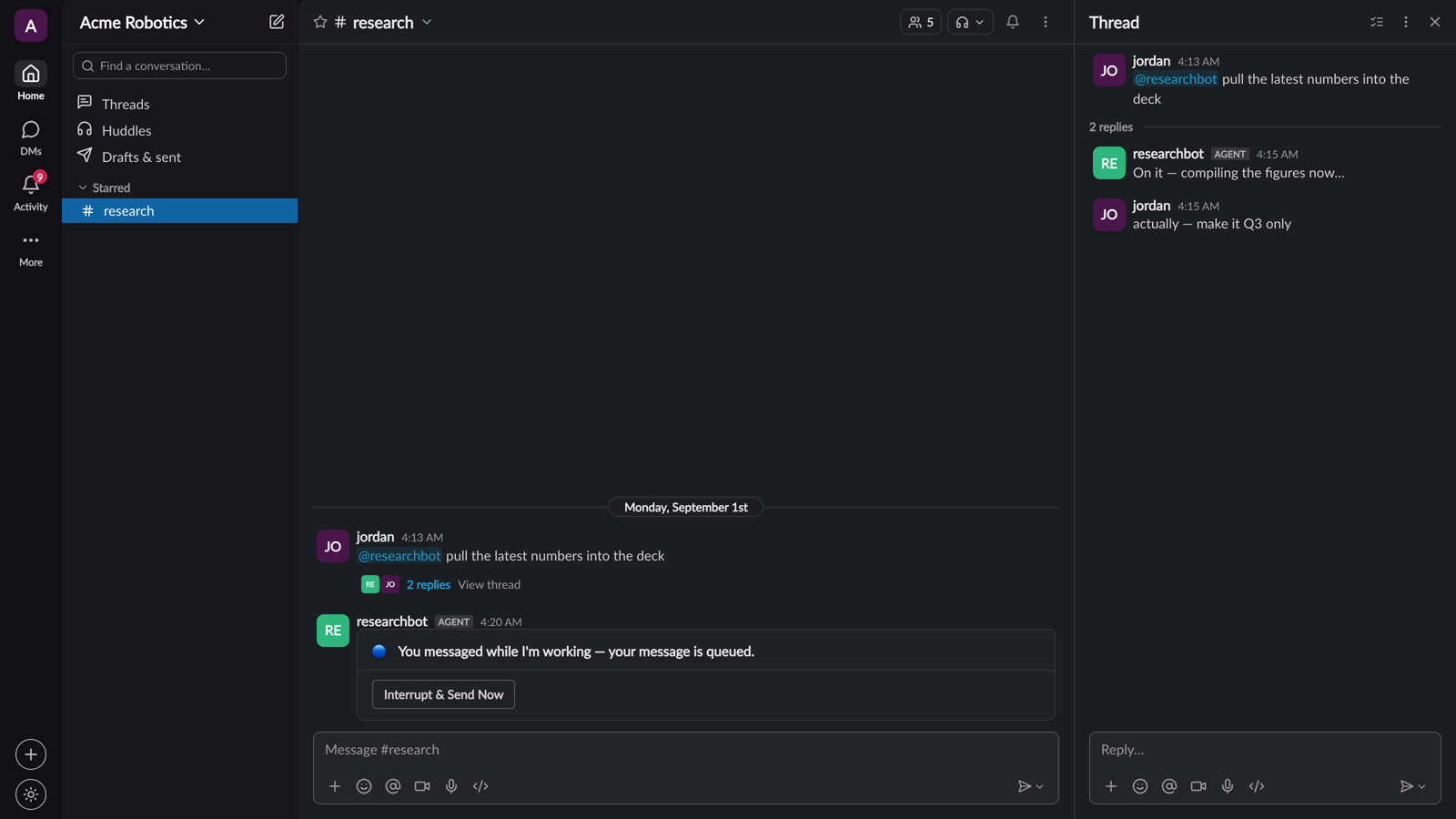
While the agent is mid-turn, you're not locked out. A message you send is acknowledged and queued for the next turn — or, if it's urgent, it interrupts the in-flight work and is delivered right away. Either way you stay in the loop instead of waiting for the turn to finish.